
درسنامه آموزشی زبان انگلیسی (3) کلاس دوازدهم
درس 1: Sense of Appreciation
Interesting Facts:
- Helping others lowers blood pressure.
- Kindness boosts energy and strength in elderly people.
- Teenagers who help others are more successful in life.
- Listening to the advice of older people improves our lives.
- Taking care of grandchildren increases brain function and memory.
Get Ready
A. Match the pictures with the following sentences.
|
|
|
|
|

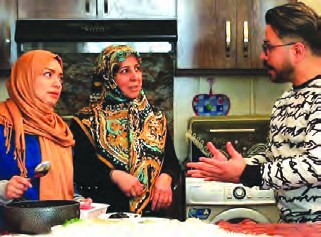
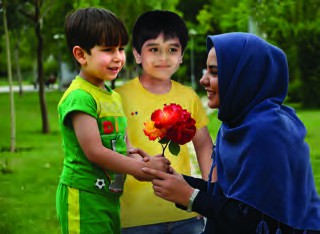
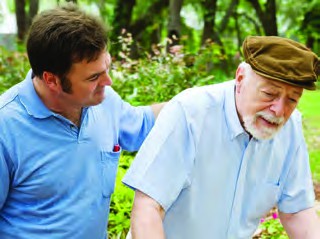
1. Children should respect their parents.
2. We have to take care of elderly people.
3. Family members should listen to each other.
4. We can help many people by donating what they need.
B. Why are these people famous?
1. Rizali Khajavi
2. Hassan Omidzadeh
3. Jabbar Baghcheban
4. Abbas Babaei
How do you feel when you read about these people?
C. Write appropriate nouns after the following adjectives. Then check (+) the positive adjectives.
.... a polite .......... .
.... a cruel .......... .
.... some lazy .......... .
.... two kind .......... .
.... a loving .......... .
.... some careful .......... .
Conversation
Sara has been in the Children’s Medical Center for a week. She has caught a terrible flu. The doctor told her to stay there to get better. There is a photograph of an old man on the wall. While the nurse is taking her temperature, they start talking.
Sara: Excuse me, who is that man in the picture?
Nurse: Oh, don’t you know him? Have you ever heard of Dr.Mohammad Gharib?
Sara: I guess I have only seen his name in my English book, but I’m not sure about it.
Nurse: Dr. Gharib was a famous physician.
Sara: Oh,… can you tell me a little about his life?
Nurse: Dr. Gharib was born in Tehran in 1288. After receiving his diploma, he went abroad to study medicine. In 1316 he became a physician and then came back to his homeland. In 1347 this center was founded by Dr. Gharib and one of his close friends.
Sara: Really? I didn’t know that.
Nurse: Dr. Gharib was also a generous man. He spared no pains to cure sick children. He was very friendly and helpful to poor families. Not surprisingly, he was regarded as a dedicated physician.
Sara: It’s a pity! I didn’t know such a great man.
Nurse: He was known as a distinguished university professor, too. The first Persian textbook on children’s diseases was written by him. He taught medicine to thousands of students.
Sara: Oh, what a great man he was!
Nurse: By the way, it might be interesting to know that your physician was one of Dr. Gharib’s students!
Sara: Really?! That’s interesting!
?????
Questions
Answer the following questions orally.
1. When was Dr. Gharib born?
2. Why was Dr. Gharib regarded as a kind physician?
3. Have you seen Dr. Gharib TV series?
??
New Words & Expressions
A. Look, Read and Practice.
|
Hamid sits on the sofa and watches TV all the time. |
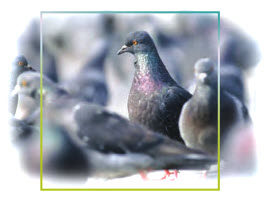
My grandfather feeds the pigeons in the park every morning. |
|
Dad really shouted at me when I didn’t do my homework. |
We have to speak louder, because my grandmother is hard of hearing. |
|
Ferdowsi was born in a village near Toos. |
My uncle went to his son and hugged him. |
|
My little sister sits on my mother’s lap all the time.. |
|


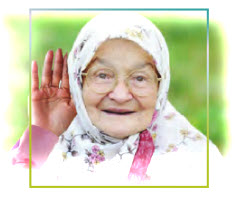
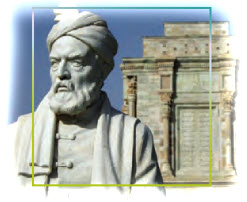

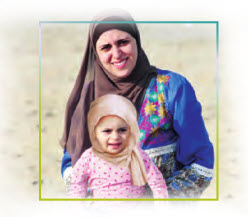
B. Read and Practice.
burst into tears: to cry suddenly
Aida burst into tears when she saw her score.
repeatedly: many times
I’ve told Mohsen repeatedly to talk politely to his teachers.
forgive: to stop being angry with someone
Mom forgave me for breaking the vase.
calmly: in a quiet way
He always speaks slowly and calmly.
diary: a book in which you record your thoughts or feelings or what has happened every day.
I have kept a diary for twelve years.
.....
C. Go to Part ‘Vocabulary’ of your Workbook and do B and C.
Reading
Respect your Parents
On a spring morning, an old woman was sitting on the sofa in her house. Her young son was reading a newspaper. Suddenly a pigeon sat on the window.
The mother asked her son quietly, “What is this?” The son replied: “It is a pigeon”. After a few minutes, she asked her son for the second time, “What is this?” The son said, “Mom, I have just told you, “It is a pigeon, a pigeon”. After a little while, the old mother asked her son for the third time, “What is this?” This time the son shouted at his mother, “Why do you keep asking me the same question again and again? Are you hard of hearing?”
A little later, the mother went to her room and came back with an old diary. She said, “My dear son, I bought this diary when you were born”. Then, she opened a page and kindly asked her son to read that page. The son looked at the page, paused and started reading it aloud:
Suddenly the son burst into tears, hugged his old mother and said repeatedly, “Mom, mom, forgive me; please forgive me.” The old woman hugged her son, kissed him and said calmly, “We must care for those who once cared for us. We all know how parents cared for their children for every little thing. Children must love them, respect them, and care for them”.
.............
Reading Comprehension
A. Read the passage. Generate at least five questions with the question starters and then answer them.
1-
2-
3-
4-
5-
B. Skim the ‘Reading’. Write its main idea.
C. Read the ‘Reading’. Find what these words refer to.
her (paragraph 1, line 2) ..........
his (paragraph 2, line 5) ..........
you (paragraph 3, line 2) ..........
me (paragraph 4, line 5) ..........
them (paragraph 5, line 6) ..........
Vocabulary Development
A. Without looking back at the Conversation, make collocations by matching the words on the left with the ones on the right column.
1. feel ............ abroad
2. take ............ well
3. go ............ surprisingly
4. spare ............ temperature
5. not ............ the way
6. by ............ no pains
7. burst into ............ tears
B. With a classmate, check the answers by looking for the collocations in the Conversation. Use each collocation in a new sentence.
1. ...............
2. ...............
3. ...............
4. ...............
5. ...............
Grammar
A. Read the following texts.
B. Read the following example sentences.
| Active | Passive | |
|---|---|---|
| She makes pancakes every morning. | Pancakes are made every morning. | |
| Ali broke the window yesterday. | The window was broken yesterday. | |
| They have fixed the cars. | The cars have been fixed. | |
| Alexander Fleming discovered penicillin. | Penicillin was discovered by Alexander Fleming. | |
| Scientists find solutions to problems. | Solutions to problems are found by scientists. | |
| Doctors have made a new medicine to cure cancer. | A new medicine has been made by doctors to cure cancer. | |
1. Anno Domini: Used after a date to show that it is after the birth of Christ.
C. Tell your teacher how ‘passive voice’ is made.
D. Read the Conversation and underline all ‘passive voices’.
E. Read the following paragraph and choose the best verb forms.
Many products (are developed/developed) each year. Light bulb, camera, airplane, and telephone (were invented/invented) by scientists and inventors. Laptops, smart phones, and tablets (were made/made) by lots of work. But not all products (are developed/developed) by hard work. Some inventions (were created/ are created) by accident or scientists’
mistakes. Penicillin, for instance, (was discovered/were discovered) quite accidentally when Alexander Fleming (was working/ was worked) on bacteria. Microwave oven also (was invented/invented) during a scientist’s experiment on energy. More interestingly, some tools and technologies (are not made/do not make) by scientists at all. Some like dishwashers and computer games (were made/made) by ordinary people like workers, housewives and school students.
F. Pair up and talk about the things that happened in the past without mentioning the doer.
Example: The window was broken.
.....
G. Go to Part ‘Grammar’ of your Workbook and do A and B.
See Also (Tag questions)
A. Read the following example sentences.
Mina is happy, isn’t she?
He’s writing an email, isn’t he?
George wasn’t hungry, was he?
The girls were weaving a carpet, weren’t they?
They are going to Hamedan, aren’t they?
His father won’t buy a new car, will he?
The boys have broken the window, haven’t they?
Your sister has passed the exam, hasn’t she?
B. Go to Part ‘Grammar’ of your Workbook and do C.
Listening & Speaking
A. We use ‘tag questions’ for two reasons: eliciting agreement (confirming facts) and signaling uncertainty.
- Sam has not come to work. I’ve heard he’s sick, isn’t he?
- Oh, yes. He was not well yesterday.
- What’s wrong with him?
- The doctors are checking his health condition.
- It isn’t something serious, is it?
- I hope not.
....
B. Listen to the following conversations and answer the questions.
Conversation 1
Why is Amin busy these days?
What does Behzad think about health?
Conversation 2
Where are they going?
Why does Mina prefer chess?
Writing
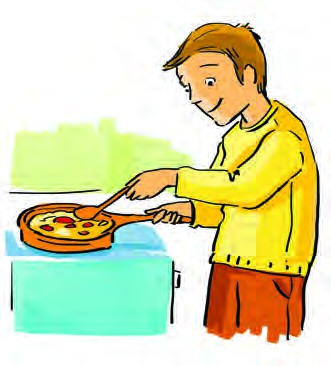
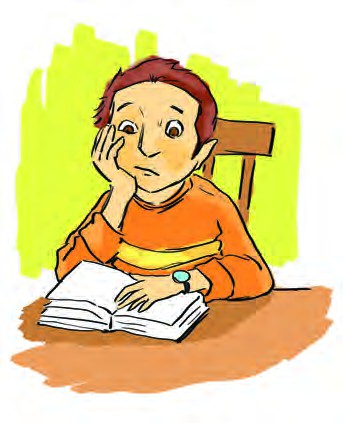
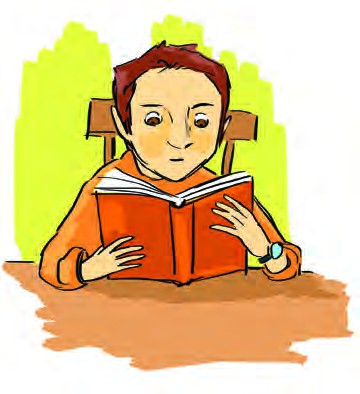
A. Complete the following sentences with ‘and’ or ‘but’.
1) We went to the park yesterday, ................... we had a wonderful time.
2) Behnam’s family went to the zoo last week, ................... they did not enjoy it.
3) Susan has a pink dress, ................... she never wears it.
4) Kate saw Sofia, ................... she didn’t speak to her.
5) My English class is really enjoyable, ................... I have a lot of homework.
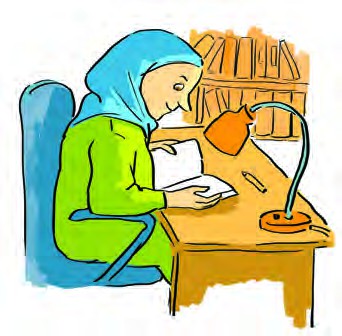
B. Complete the following sentences with ‘or’ or ‘so’.
1. My mother doesn’t like fast food, ............. she doesn’t eat any.
2. I go out tonight, ............. I take a rest.
3. We can eat our lunch at the restaurant, ............. we can have it at home.
4. That dictionary is expensive, ............. I can’t buy it.
5. This dress is not comfortable, ............. she rarely wears it.
C. Combine the two sentences with ‘and’, ‘but’, ‘or’ or ‘so’.
1. Joseph is very busy today. He cannot watch TV.
2. My brother has a lot of books. He never reads them.
3. We should do a lot of homework. We don’t have enough time.
4. Sepideh likes spaghetti. Her grandmother hates spaghetti.
5. You can buy this coat. You can buy those shoes.
D. Complete the sentences.
1. I like learning Chinese, but .............................. .
2. These shoes are not comfortable, so .............................. .
3. You must study well, and .............................. .
4. I like swimming, but .............................. .
5. You can install a mobile dictionary, or .............................. .
E. Write five real compound sentences about yourself, your family or friends.
1.
2.
3.
4.
5.
F. Go back to the Reading. Find three simple and three compound sentences. Underline the subjects and circle the verbs.
1.
2.
3.
4.
5.
What You Learned
A. Listen to the first part of an interview.
1. Answer the following questions based on what you just heard.
a. Why is knowing about the experience of our parents important?
b. Why are our parents our first teachers?
2. Listen again and write down three important points mentioned.
B. Now read the rest.
Yet another important thing is our heritage and culture. We have much to learn from our parents regarding our heritage, to be proud of our past. This heritage and history brings a sense of belonging. Most importantly, it brings us a sense of identity of our past and the responsibility to protect it for our future generations. What I can add at the end is the role of our parents’ morals, values, and principles in our lives. Our elders have either learned, created or have been brought up with a set of morals, values and principles in their lives. Our elders want the best for
us and they are willing to tell us what set of rules and guidelines have made them successful, and hopefully, peaceful.
3. Underline all ‘passive tenses’. Make three questions about the important points. Then answer them.
C. Work in pairs. Ask and answer.
- How can we learn from our parents in our lives?
- How important is it to protect our culture for our next generation?
- Why are our parents our blessing?